
It used to be easy to lift weights — mostly because my job made it effortless. In my mid-30s, I worked at a fitness club, taught group fitness, and was among the first instructors to introduce Les Mills Body Pump in Geneva. I also trained 3–5 clients per week as a personal trainer. Back then, the gym was my natural habitat — weights were just part of my daily life.
But by my mid-40s, I drifted into yoga as my sole form of exercise. Yoga was grounding, calming, and spiritually enriching… but as time passed, I noticed I wasn’t maintaining the same strength or muscle tone. Something was missing.
Fast forward to 2025 — I’m now in the 50+ club, and suddenly lifting weights has become a hot topic among my peers, my students, and in the wellness world.
And honestly? It can feel confusing.
Everyone agrees that the 50+ body benefits from resistance training: increased bone density, better joint stability, improved metabolism, hormonal support, better posture, and even cognitive health. But how to do it properly? That’s where it gets muddy.
So I did some digging — research, listening to experts, experimenting, and tuning into my own body. And I want to share what I’ve found, in hopes that it can help not only my students, but anyone navigating this stage of life with curiosity and self-care.
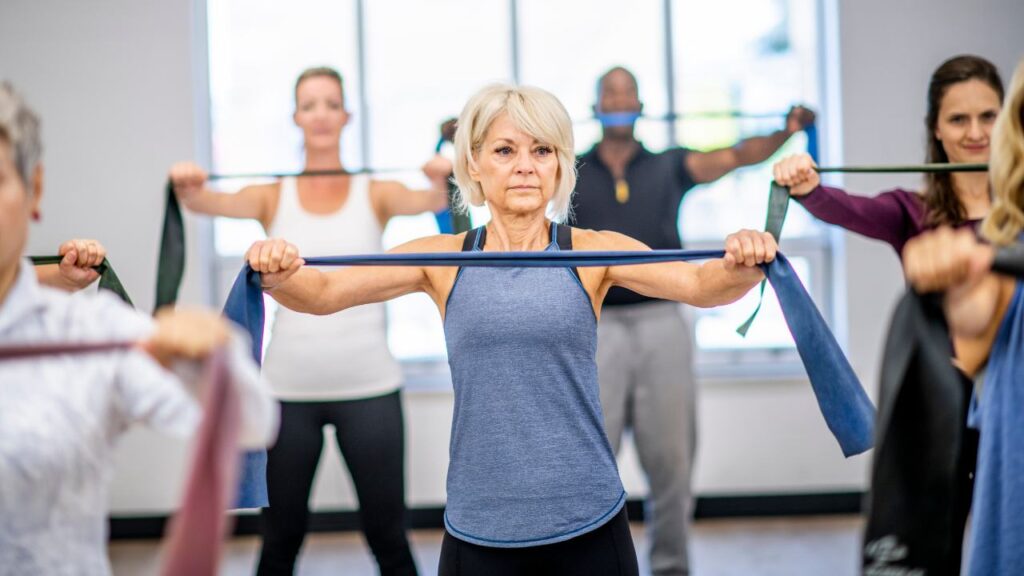
First: What is resistance training?
Resistance training is any form of exercise where your muscles contract against an external force. The “resistance” can come from:
- free weights (dumbbells, barbells, kettlebells)
- weight machines
- resistance bands
- your own body weight (push-ups, squats, pull-ups)
- medicine balls, cables, etc.
The key is simple: your muscles are working against a load, which stimulates them to adapt — to become stronger, harder, more resilient.
There are generally three ranges of resistance training:
- Heavy weights: (80%+ of your 1‑rep max) for 2–6 repetitions
- Moderate weights: for 6–15 repetitions
- Light weights: for 15–30+ repetitions
And here’s the really encouraging part:
Of the studies reviewed comparing heavy, moderate, and light weights — ALL showed muscle development and strength gains when training close to failure.
Meaning, as long as that last rep is truly challenging — whether it’s rep #5 or rep #20 — you are stimulating growth.
This is fantastic news, especially for those without access to barbells, squat racks, or piles of heavy plates.
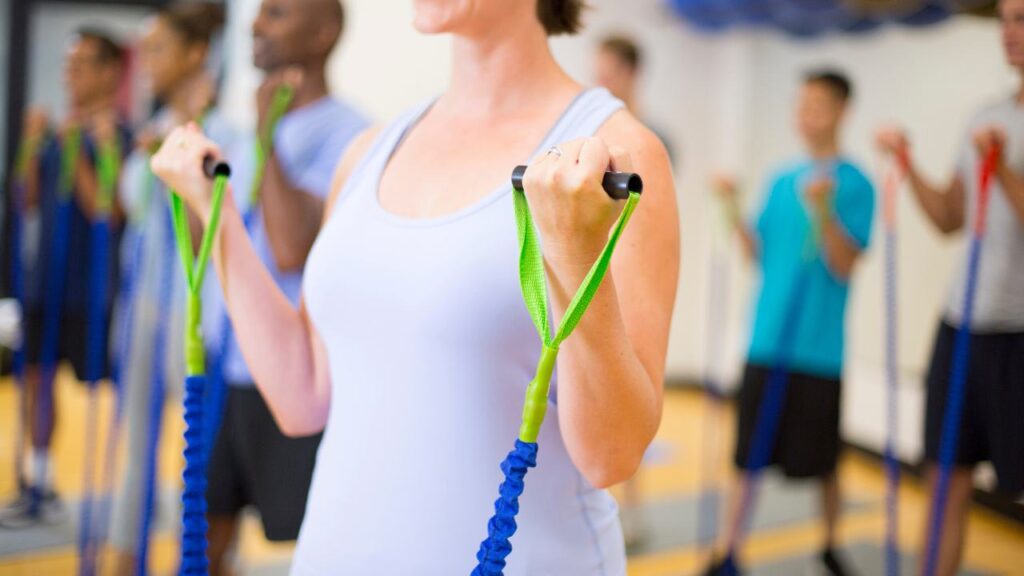
Here’s how I see the pros and cons of each method:
1. Heavy Weights, low reps (2-6)
Pros:
- Efficient strength building
- Strong neurological adaptations (your nervous system gets better at activating muscle)
- Results can come quickly
- There’s a wealth of tutorials, programs, and communities around heavy lifting
- Great for experienced lifters who want to push strength boundaries 1–2 times per week
Cons:
- Requires access to heavier equipment
- Higher risk of joint stress — especially for shoulders, back, knees, hips
- Not ideal if you have pelvic floor concerns (bearing down under heavy load can aggravate symptoms)
- Longer rest periods mean lower calorie burn during workouts
- Can feel repetitive or “grindy” if you don’t love the style
2. Moderate Weights, mid-range reps (6-15)
Pros:
- Builds size and strength steadily and safely
- Can be done at home with just dumbbells, bands, and maybe a box or step
- Great balance between effort and joint comfort
- “Failure” is achievable without straining or bracing dangerously
- Sessions can be short — 25–35 minutes
- Wonderful for overall functional strength — the kind that helps you move confidently through daily life
Cons:
- Requires variation to keep the body adapting (you can’t just repeat the same 5 exercises forever)
- You need to pay attention to form and alignment
- If you self‑guide, creating fresh routines can get mentally tiring — hello, “workout planning burnout!”
3. Light Weights & Bodyweight Training (15-30+ reps)
Pros:
- Accessible — anyone can start immediately
- Low risk of injury
- Excellent for building endurance and tendon/ligament resilience
- Great for beginners or those returning from injury
- Can be paired with breathing, tempo pacing, and control for deep muscle activation
- Excellent for improving mobility and balance
Cons:
- To get results, you really must work close to failure — which means those high reps need to burn
- Progression can be slow if reps are too easy
- Without challenge, it can turn into “just movement” rather than “muscle training”
Why my Resistance Training classes are designed this way
My classes intentionally focus on moderate weights and bodyweight/light resistance work — because this approach makes strength training:
- accessible for all fitness levels (even experienced lifters!!)
- joint‑friendly
- pelvic‑floor‑safe
- sustainable over time
- effective for building real‑life functional strength
- doable at home or in studio
- and I do the programming for you! (no need to research exercises)
You don’t need barbells or intimidating heavy plates — just guided movement, mindful effort, and consistency.
A gentle closing thought
If there’s one message to take away, I hope it’s this:
You don’t have to lift heavy to be strong. You just have to lift with intention.
Whatever load you choose — light, moderate, or heavy — if the final reps are truly challenging, you are stimulating muscle and strength.
So choose the style that suits your life, your body, and your joy.
Lift with curiosity. Lift with compassion. Lift with connection to the body you’re living in.
And remember: it’s never too late to get stronger.
If you have comments or questions, drop them below — I will read and respond ❤️
If you’re curious about trying resistance training — or you’d like to experience this warm, supportive, moderate‑and‑light approach firsthand — simply let me know you’re interested. I’d love to have you join us and help you feel stronger, steadier, and more at home in your body.Stay strong and stay well,
Annie
Key research articles & reviews
- Strength and hypertrophy adaptations between low‑ vs. high‑load resistance training: a systematic review and meta‑analysis — by B.J. Schoenfeld et al., 2017.
- This widely-cited meta-analysis found that hypertrophy (muscle size) gains were similar between low- and high-load training, while 1RM strength increased more with high-load. PubMed+2Elements System+2
- The Effects of Low‑Load vs. High‑Load Resistance Training on Muscle Fiber Hypertrophy: A Meta‑Analysis— by J. Grgic, 2020.
- This paper looked specifically at fibre-level hypertrophy (type I and type II fibers) and found no significant difference between low-load and high-load protocols, when training was to failure. PMC+1
- Muscle hypertrophy and strength gains after resistance training with different loads but equal volume — by L. Carvalho et al., 2022.
- This study showed that even when total volume was matched, higher loads elicited greater gains in maximal strength, while hypertrophy was similar regardless of load magnitude. PubMed+1
- Resistance training prescription for muscle strength and hypertrophy in healthy adults: a systematic review and Bayesian network meta‑analysis — 2023 (in British Journal of Sports Medicine).
- This recent network meta-analysis reaffirms that higher-load training (> ~80% 1RM) maximizes strength gains, but also indicates that across a variety of loads, hypertrophy remains achievable. bjsm.bmj.com+1
- Resistance Training Variables for Optimization of Muscle Hypertrophy: An Umbrella Review — by R. Bernárdez-Vázquez et al., 2022.
- This umbrella review synthesises multiple meta-analyses to offer practical recommendations: load is only one among many important variables (volume, frequency, effort, recovery) — and when manipulated properly, a wide range of loads can produce hypertrophy.